The 4 new housing laws hitting the Austin, TX area are nowhere near as wild as the headlines make them sound. Only 2 of them apply inside Austin city limits, and the one that matters most for the north side suburbs isn't about houses at all. It's about water.
Every time a new housing law passes in Texas, the headlines make it sound like the whole neighborhood is going down: trailer parks next door, a fourplex in your backyard, prices dropping. Everything is being massively exaggerated. Here's what actually changed as of November 19, 2026, who each law really touches, and what to check before you buy.
Key takeaways
- Senate Bill 785 makes almost every Texas city with zoning allow new manufactured homes by right in at least one residential zone, but it doesn't override private deed restrictions written before 2025.
- Prop 4 sends the next billion dollars of state sales tax collections above a set line each year into the Texas Water Fund for about 20 years, which adds up to the $20 billion in the headlines.
- Austin's new mixed-use zones aim to keep auto-oriented uses like drive-throughs out of walkable areas, but nothing is final and the zones only apply when land gets rezoned into them.
- Austin's missing middle zones would allow up to 4 or up to 6 homes on a regular Austin lot, while the north side suburbs are under the size line for the state's own small lot law.
- Before buying, ask whether the address is inside Austin city limits, what the zoning and deed restrictions say, and where the water comes from.
What does the new Texas manufactured home law change?
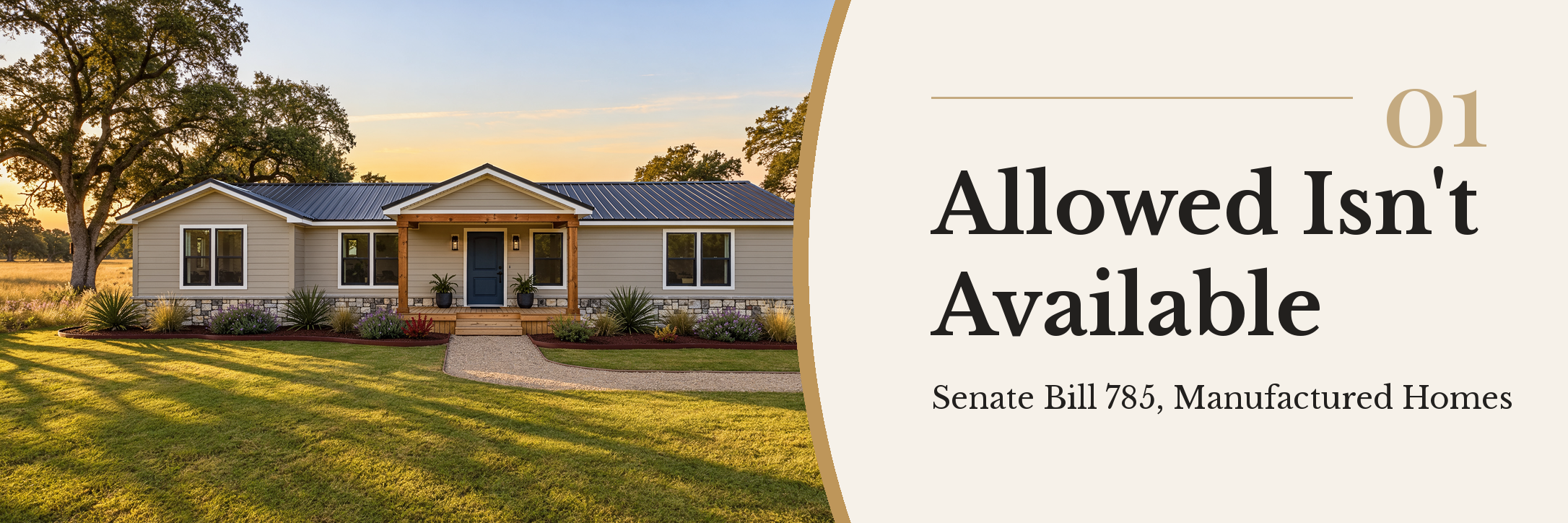
Almost every city in Texas with zoning now has to allow new manufactured homes in at least one residential zone, by right. The law is Senate Bill 785, and as of November 19, 2026 it has been in effect since September. By right means that if your lot sits in that zone and the home follows the rules, the city can't drag you through a special hearing to get a yes.
That's a bigger deal than it sounds, because a lot of cities simply didn't allow this before. Some had no zone for them at all. Others only allowed them with a special permit and a public hearing, which is a great way to make sure nobody bothers. Roughly a third of the cities in Texas had to rewrite their rules entirely to comply.
The city is on a clock now, too. If you apply to put one on a lot, it's considered approved unless the city tells you no, in writing, with a reason, within 45 days.
What kind of manufactured homes does the law cover?
When you hear manufactured homes, you probably picture an old single wide with a tarp on the roof. That's where my head went too, before I dug deeper into this. But that's not what this law covers.
It only applies to brand new homes built in a factory to a federal standard, which covers things like fire safety and energy efficiency. Used homes and the old mobile homes from before the mid '70s don't count.
How much cheaper is a manufactured home?
Because they're built in a factory, there are no rain delays and no crew waiting around on a muddy lot, and the builder gets to crank them out at scale. As of November 19, 2026, a new manufactured home costs about half as much per square foot as a new house built on site, before you add the land.
A new multi-section home in our part of the country has been selling for somewhere around the low $160,000s. That's just the house: no dirt, no utilities, no setup. Compare that to the typical home in Round Rock right now, which runs somewhere in the high 300s to the low 400s. Even after you buy the land, you can see why people are looking at this as an alternative to a traditional house.
Can a manufactured home go up in my HOA neighborhood?
Almost certainly not. The law doesn't override private deed restrictions written before 2025. Think about what the north side is made of: Avery Ranch, Terra Vista, Wolf Ranch, all master planned neighborhoods with HOAs, and HOAs run on deed restrictions.
If you're worried one of these is about to show up next to your new build, it almost certainly isn't. And if you were hoping this means a cheap lot in a nice HOA neighborhood, sorry, it ain't happening.
There's a second catch. Allowed doesn't mean available. Cities still get to pick where the zone goes and how big it is, and the final law only asks for "an area of land," which can be pretty small. Pearland, down by Houston, already had a zone for some of these homes, but you need at least 3 acres to use it. Other cities are putting the new zone right where manufactured homes already sit. Up here, cities are still working out exactly where these zones land, and Round Rock already had a manufactured housing district on the books.
Who should pay attention to the manufactured home law?
First time buyers trying to squeeze into the north side, and anyone looking at land toward Liberty Hill, Jarrell, or Taylor. Landowners should pay attention too, because once a city creates one of these zones, any owner can ask to be rezoned into it.
If you're worried about a manufactured home near a lot you're considering, be systematic about it:
- Check the zoning map.
- Check the deed restrictions.
- Check the lot size and the design rules.
- Check that the land has utilities.
Skip one of those, and the cheap option gets expensive really fast. If you're selling in an established HOA neighborhood, this shouldn't scare off your buyers. Expect somebody to ask about it anyway, and have the deed restrictions ready to answer.
How does Prop 4 affect water for North Austin, TX?
Prop 4 builds a long-term state pot of water money that North Austin cities can go after, but it doesn't pick projects and it won't put shovels in the ground tomorrow. Nobody moves to Leander because of the water supply, but the water supply might decide how long Leander gets to keep growing.
Texas voters approved Proposition 4, which changed the state constitution to set aside existing sales tax money for water. Once the state's sales tax collections pass a certain line each year, the next billion dollars goes into the Texas Water Fund, and that runs for about 20 years. Add it up, and you get the $20 billion in the headlines.
Does Prop 4 raise your taxes?
No. It sets aside sales tax money the state was already collecting, so your taxes are not getting hiked because of this. The money goes toward new water supply, flood control, and fixing old systems, and at least half has to go to new supply and the state's water infrastructure loan program.
When will Prop 4 money reach water projects?
Not right away. Cities and water providers still have to come up with plans and go after the money. The first chance to actually spend it comes when lawmakers write the next state budget, and if we're being real, projects probably won't see that money until around 2029.
And $20 billion doesn't solve everything. Texas needs several times that over the next 50 years. I think of it as a down payment: still a big deal, but we have a long way to go.
Why does water matter more on the north side?
Williamson County is one of the fastest growing counties in the whole country, and all those new rooftops need water. Cedar Park and Leander lean mostly on Lake Travis, while Round Rock pulls from a mix of lakes and an aquifer.
Round Rock's own public works director said it plainly to county leaders: "Future water is not located in the county anymore." Cities have to go get it from somewhere else, and that gets expensive. He's also said that by 2050, Round Rock's demand for water will almost catch up to its supply. In city planning years, 2050 might as well be next Tuesday.
That's why Williamson County, Cedar Park, Leander, Round Rock, Georgetown, and the Brazos River Authority teamed up on a long-range water study. Everything is on the table: new lake water, new groundwater, water reuse, fixing old infrastructure, and a shared conservation plan. Results are expected around the end of 2026 or into 2027. The county is paying for the study itself, but the money for whatever it recommends isn't lined up yet. That's the gap Prop 4 is built for.
Has state water money worked up here before?
Yes. Lake Travis droughts got so bad that the old floating intake barges on the lake stopped working. So Cedar Park, Leander, and Round Rock dug tunnels deep under the lake to keep pumping water even when the lake drops. Round Rock figures that extra water should carry the city for the next 30 or 40 years, and that project got help from a state loan out of one of the same funds Prop 4 is set to keep filling.
If you're buying in Leander, Cedar Park, Liberty Hill, or Georgetown, or you're a long-term owner up here, this is the one to follow. Reliable water is what keeps people wanting to live where you live.
Will Austin, TX ban drive-throughs with its new mixed-use zones?
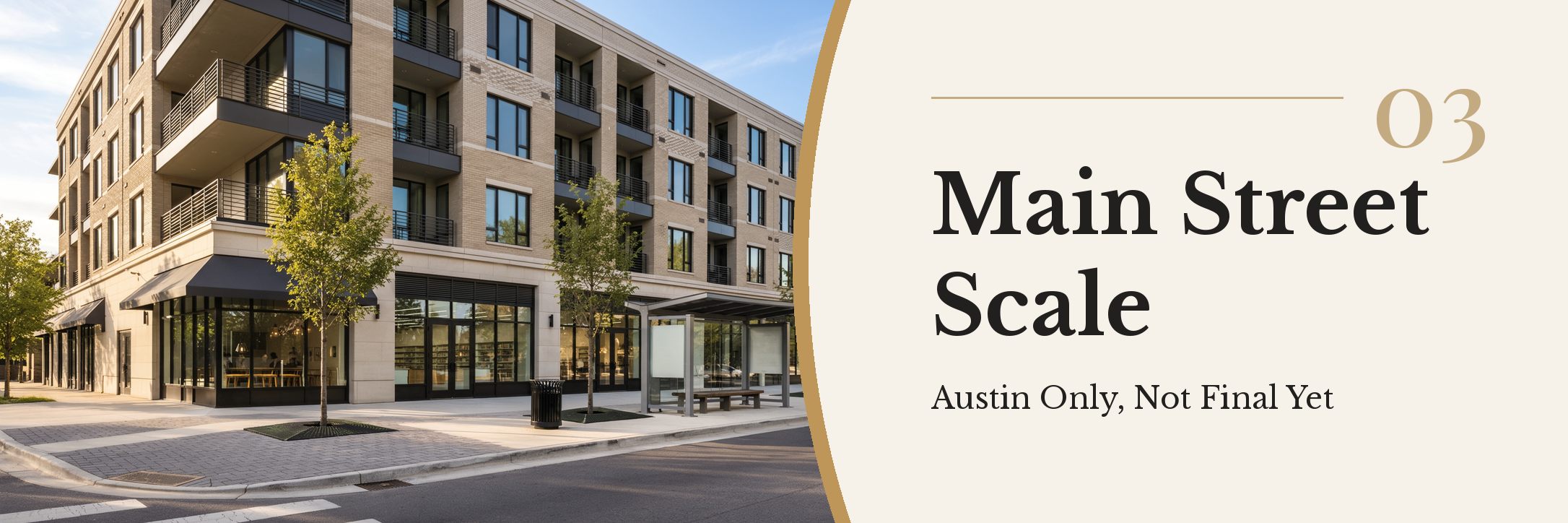
In parts of Austin, possibly, but not anytime soon and not everywhere. Austin is writing brand new mixed-use zones, and the city council told the city to design them for people on foot and keep auto-oriented uses out. That usually means car dealerships and warehouses, but drive-throughs and gas stations are the examples on the table.
Austin's code was written back in the '80s, and it mostly keeps houses, shops, and offices apart. Look at the area around the Domain: that mix of shops, offices, and homes needed its own special rules to happen. Same story for Mueller. The new zones are supposed to make that kind of place easier to build without a custom deal.
What would Austin's mixed-use zones allow?
The plan has 2 flavors. In some zones, mixing uses would just be allowed. In others, it would be required, so a building near frequent transit would need something like shops on the ground floor.
Buildings would range from a corner store up to something around 4 or 5 stories, so think Main Street scale. Why force shops onto the ground floor near transit? Because a bus stop is a lot more useful when there's coffee, a pharmacy, and a dry cleaner right there. That's the whole idea behind a walkable neighborhood.
When do Austin's mixed-use zones take effect?
None of it is final as of November 19, 2026. It still has to go through public hearings, and the city was told to bring the mixed-use piece forward sooner if it can. Even after it passes, nothing changes overnight. The new zones only apply when land actually gets rezoned into them, so the drive-throughs aren't going anywhere for now.
If you own an old strip center or retail pad in Austin, this is worth watching, because it changes what can replace it. If you're buying near a busy Austin road, it could change what goes up down the street or right next to you.
Do Austin's mixed-use zones affect the suburbs?
No. It's an Austin city rule, so it doesn't affect you if you're buying in places like Buda, Kyle, or Round Rock. Funny thing is, the north side kind of beat Austin to it already. Round Rock banned new drive-throughs in part of its downtown and opened the door to taller buildings along I-35.
Can you build a fourplex on an Austin, TX lot now?
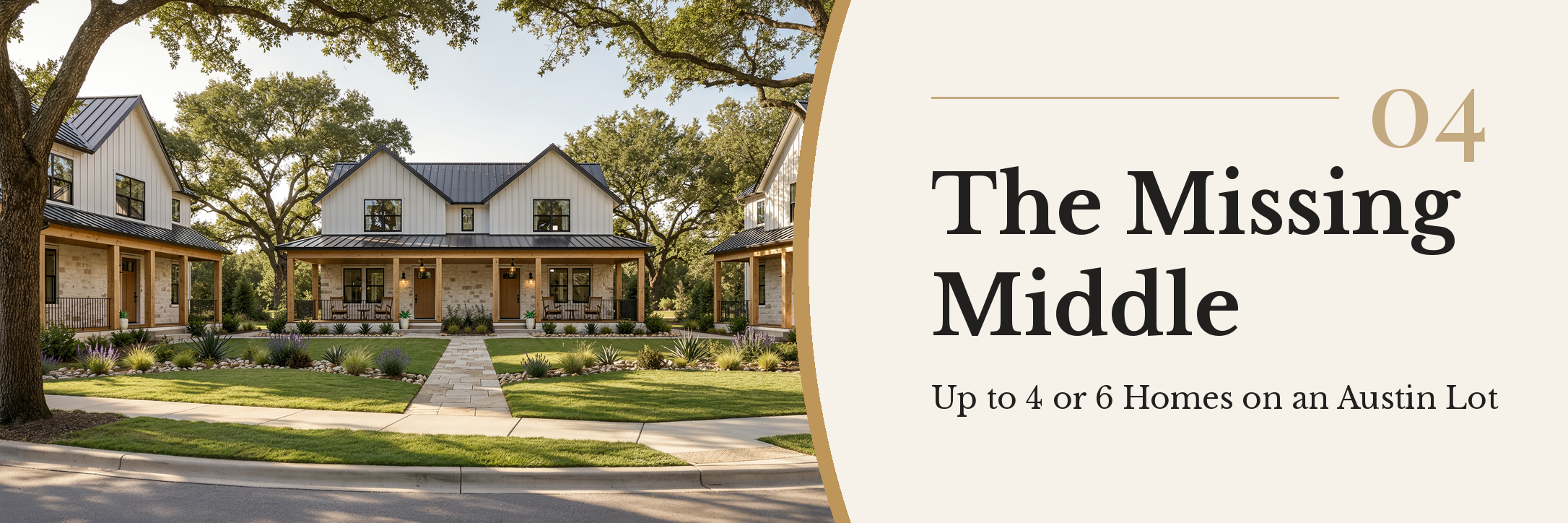
Not yet. Austin is drafting new residential zones for missing middle housing, and one would allow up to 4 homes on a regular size Austin lot while the other would allow up to 6. A property still has to get rezoned into one of them first, so nobody is dropping a plex next door overnight.
Austin is great at building 2 things: houses and giant apartment complexes. Everything in between almost never gets built. That in-between stuff is what we in the industry call the missing middle: townhomes, duplexes, fourplexes, and cottage courts, which are little homes clustered around a shared yard. Since Austin's current code took effect, less than 1% of new homes in Austin have landed in that middle range.
Why does missing middle housing matter for buyers?
Because it matters for your wallet. A townhome or a cottage court home usually comes in under a full house in the same neighborhood. When that option doesn't exist, you're stuck picking between a condo and a house you might not be able to afford.
Both new zones would keep the same height limit as a normal house. The homes would face the street, so think porches with parking tucked in the back. Austin isn't inventing this, either. Cities like Seattle and Portland already allow 4 homes on a typical lot.
Isn't this the same as Austin's 2024 lot size change?
No, don't mix the two up. Back in 2024, Austin cut the minimum lot size for a single house by about two thirds, which let people build one house on a much smaller lot. This new rewrite creates whole new zones made for small multi-unit buildings.
Timing wise, this one is expected to land after the mixed-use zones. Not everyone is on board, and plenty of people showed up to the council vote worried about what it means for single family neighborhoods, so the details could still change before anything is final.
If you own a lot in Austin, watch this one, because it could change what's legal to build on a huge share of the city. If you want something between a condo and a house, you'll probably see more of those options inside Austin over the next 5 to 10 years.
Does the missing middle law affect Round Rock and the suburbs?
Not right now. The state's own small lot law only kicks in for cities over a certain size, and the north side suburbs are all under that line. This is mostly an Austin law.
Round Rock is dipping a toe in, though. Its downtown rezoning lets you put up to 3 small buildings on a lot in one district, a little more pulled back than what we're seeing in Austin. My guess, and it's just a guess, is that the suburbs feel this pressure eventually, but nothing like Austin's rewrite is on the table up here right now.
What should you ask before buying in North Austin, TX?
Before you hire anybody to help you buy up here, ask them these 3 things:
- Is the address inside Austin city limits? The mixed-use and missing middle rewrites only touch Austin, and the city limits reach a lot farther north than most people think.
- What's this lot zoned for, and what do the deed restrictions say? A state law that allows something doesn't mean it's allowed on your street. The zoning map and the deed restrictions decide that.
- Where does this address get its water, and what's the plan for it long term? Cedar Park and Leander lean mostly on Lake Travis, and reliable water is what keeps people wanting to live where you live.
Out of all 4, water is the one I'd say decides how fast the north side keeps growing, because no zoning change can build a neighborhood without something coming out of the tap. The manufactured home law sounds like the wild one, but inside existing HOA neighborhoods up here it changes almost nothing. And as real as the Austin rewrites are, they're not your problem unless you're buying inside Austin city limits.
Ready to find out what's allowed around the address you're looking at? Begin your home search below.
Frequently asked questions
Can someone put a manufactured home next to my house in North Austin, TX?
In an established North Austin, TX HOA neighborhood, almost certainly not. Senate Bill 785 makes most Texas cities with zoning allow new manufactured homes by right in at least one residential zone, but it doesn't override private deed restrictions written before 2025. Master planned neighborhoods like Avery Ranch, Terra Vista, and Wolf Ranch run on deed restrictions, and cities still choose where the new zone goes and how big it is.
What homes does the Texas manufactured home law cover?
The Texas manufactured home law, Senate Bill 785, only covers brand new homes built in a factory to a federal standard that covers things like fire safety and energy efficiency. Used homes and the old mobile homes from before the mid '70s don't count. If you apply to place one on a lot in the right zone, it's considered approved unless the city says no, in writing, with a reason, within 45 days.
Will Prop 4 raise taxes in Texas?
No. Texas Prop 4 sets aside existing state sales tax money for water rather than raising taxes. Once sales tax collections pass a certain line each year, the next billion dollars goes into the Texas Water Fund for about 20 years, which adds up to $20 billion. Water projects North Austin, TX cities could go after probably won't see that money until around 2029, and the fund doesn't pick projects on its own.
Does Austin's mixed-use zoning apply in Round Rock, TX?
No. Austin's new mixed-use zones are an Austin city rule, so they don't apply in Round Rock, TX, Buda, Kyle, or other suburbs. In Austin, the zones aim to keep auto-oriented uses like drive-throughs and gas stations out of walkable areas, but nothing is final and they only apply when land gets rezoned. Round Rock already banned new drive-throughs in part of its downtown on its own.
How many homes could go on one Austin, TX lot under the missing middle zones?
Austin, TX is drafting 2 new residential zones: one would allow up to 4 homes on a regular size Austin lot, and the other up to 6, both at the same height limit as a normal house. A property still has to be rezoned into one first, and the details could change. The north side suburbs are under the size line for the state's own small lot law, so this is mostly an Austin change.