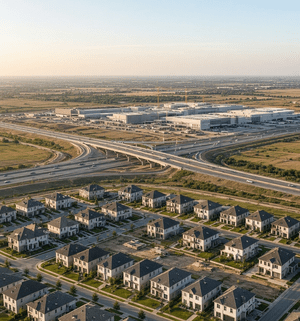
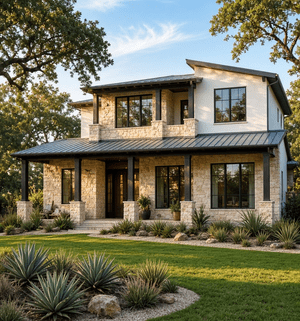
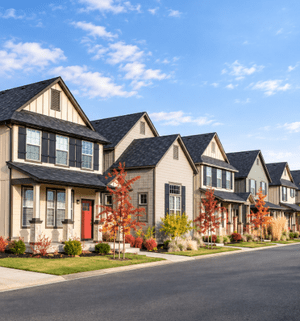
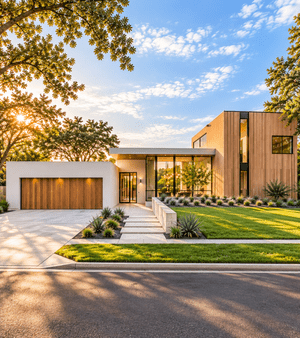
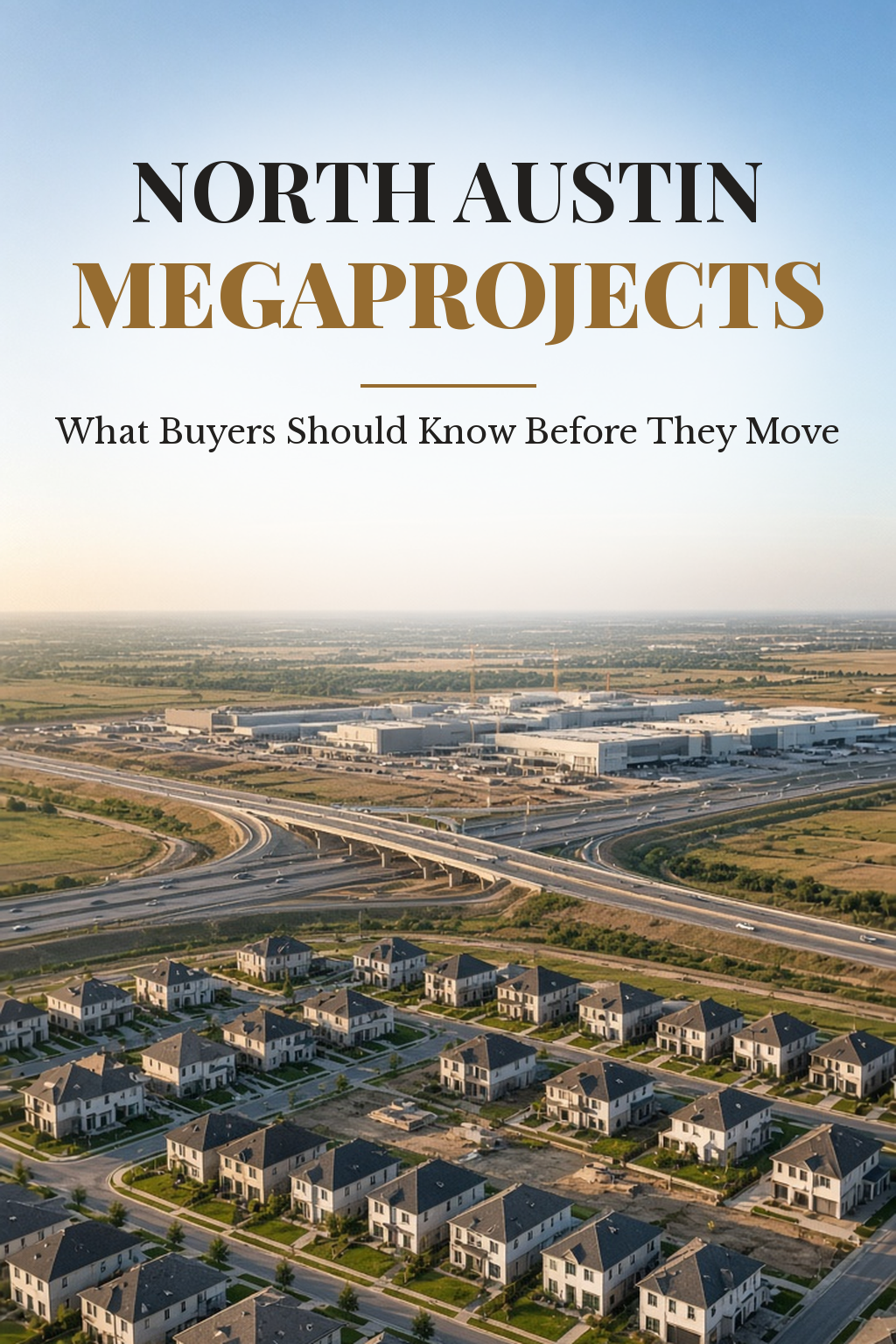
As of May 2026, North Austin has billions of dollars in megaprojects moving at the same time: Samsung's chip campus in Taylor, Flora and the Hutto Megasite in Hutto, a new town center in Leander, The District in Round Rock, Austin light rail, and the rebuilt 183 North. Jobs, roads, and density are all showing up together from Round Rock to Taylor, and the window where prices still reflect today instead of what's coming is getting tighter.
For most of Austin's run, the houses showed up first. You moved out, the neighborhood built around you, and 5 or 10 years later the roads, restaurants, and retail filled in. You were basically buying into a promise. That's not how this is playing out anymore.
Key takeaways
- As of May 2026, Samsung was aiming to have its Taylor campus running by the end of 2026, and suppliers were already moving in nearby.
- Flora in Hutto is an 835-acre community about 5 miles from Samsung, with eight builders and prices from the $300s into the $800s as of May 2026.
- Leander is building a 116-acre town center at 183 and 183A next to Leander Station, with full build-out planned for 2031.
- Round Rock's District is going vertical across from Dell while home values there have pulled back from their peak.
- The 183 North express lanes are open, which makes Cedar Park and Leander a much easier commute into Austin.
Why is North Austin growing differently in 2026?
Because jobs, infrastructure, and density are all showing up at once, not years after the houses. You've got a semiconductor plant bringing in thousands of jobs, highway projects that are already open, a light rail system with a signed construction contract, and master-planned communities with resort-style amenities on day one.
Williamson County has been one of the fastest-growing counties in the country for years. What's going on now is different from the usual suburban growth. It's a metro starting to take shape.
If you're buying, that difference matters more than people think. Getting into a place that's still forming is a completely different move than buying somewhere that's already topped out.
What is Samsung building in Taylor, TX?
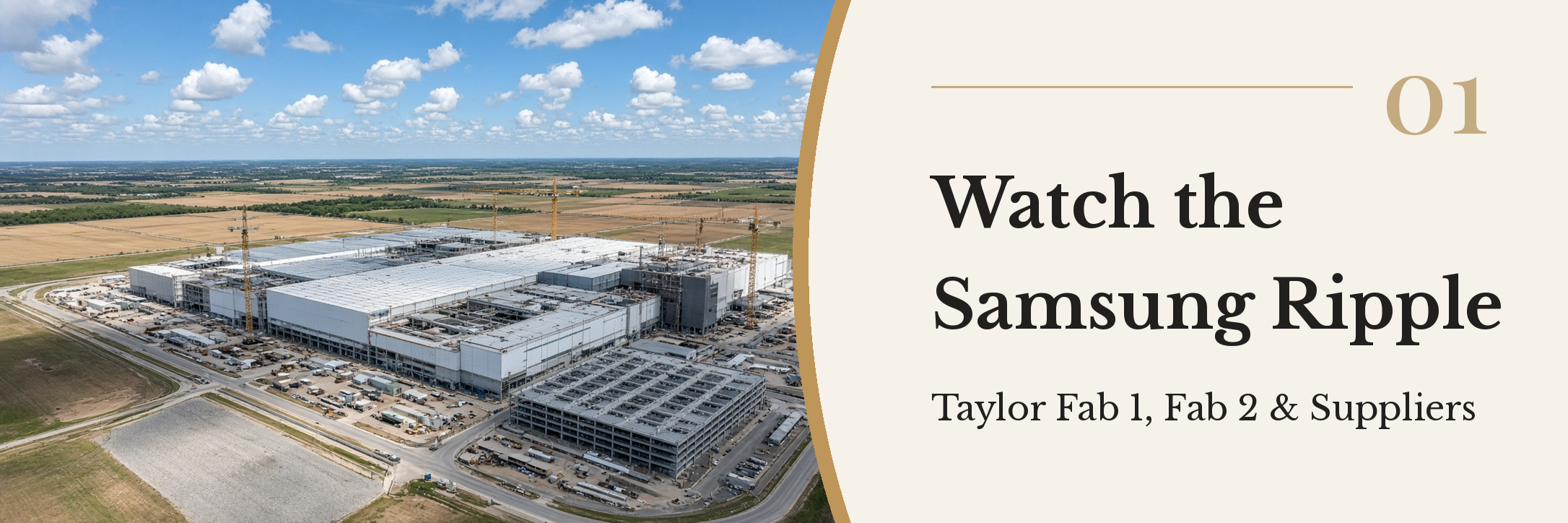
Samsung is building a semiconductor campus on about 1,200 acres in Taylor, about 35 miles northeast of downtown Austin. It started as the largest foreign investment in Texas history, and it's the anchor for everything else in this post.
Fab 1 has been under construction since 2022. As of late 2025, employees were already moving into the office building on site, and Samsung is aiming to have operations up and running by the end of 2026.
In March 2026, the Austin Business Journal reported that Samsung is already working through approvals for Fab 2, a second facility. There's no set timeline yet, but demand is picking up even before Fab 1 is live.
Samsung's 2024 economic impact report showed its Austin and Taylor campuses together pushed close to $20 billion into the Central Texas economy in year one. That supported tens of thousands of jobs and hundreds of millions in tax revenue, all before production even started in Taylor.
Why do Samsung's suppliers matter for buyers?
Because the ripple is already starting. Around 150 supplier companies need to be within about an hour of the Taylor site, and a lot of them are already showing up. A South Korean semiconductor materials company is building a big facility in Taylor just to support the campus.
The workforce pipeline is being built at the same time. Texas A&M broke ground on a new semiconductor research center in April 2026. The areas closest to all of this are the first to feel the demand.
What is Flora in Hutto, TX?
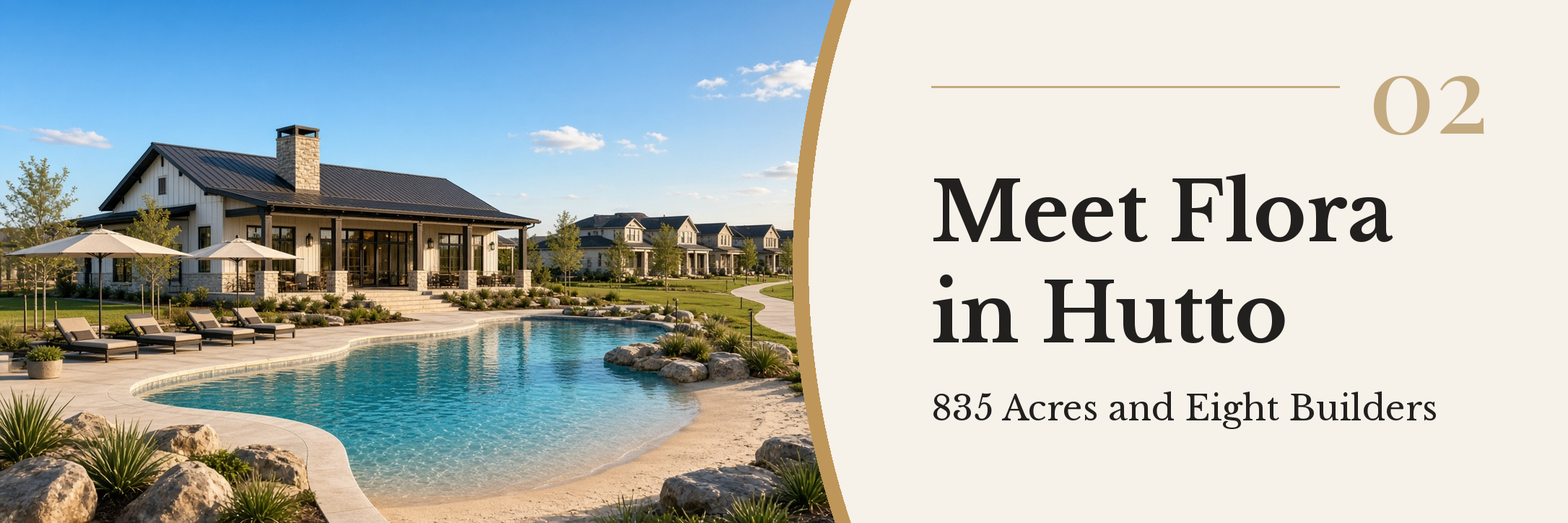
Flora is an 835-acre master-planned community in Hutto, about 5 miles from Samsung's front gate. At full build-out, it's expected to bring about 2,800 single-family homes.
I'll be up front about something. I can see Flora being built from my house, and Samsung is about 5 miles the other way. I'm watching both of them move in real time.
As of May 2026, phase one is open and selling with eight builders: Brightland, DRB, Empire, Highland, Meritage, Perry, Tri Pointe, and Weston Homes. Pricing starts in the $300s and goes into the $800s, depending on the builder and the level you pick.
The homes are only part of it. The whole setup is built around a central market square, with:
- A clubhouse with a co-working space and a coffee bar
- Resort-style pools with beach entry, plus a splash pad
- A fitness center and a full-time lifestyle director
- Parks and trails running along a creek through the property
From day one, it already feels like a place that's been there for years. The connection to Samsung is direct. Employees, suppliers, and the service businesses that follow all need housing close by, and they want it to feel like an actual neighborhood.
What is happening at the Hutto Megasite?
The Hutto Megasite is about 1,400 acres along Highway 79, right between Austin and the Samsung site, and it finally started moving when its main road opened in late 2025. For years it was all potential. Without a main road through the middle, the land deals, the utilities, and the fire access couldn't get going.
Williamson County Economic Development confirmed four major land deals plus a wave of large industrial projects that were all waiting on that road. Hutto is now on track for tens of billions of dollars in investment and thousands of jobs.
The biggest project out there right now is PowerCampus Austin, a joint venture between Skybox Datacenters and Prologis built on large-scale data centers, with at least $10 billion going into it. As of May 2026, the first building is fully leased and the first group of buildings is working toward completion.
Right next to it, a 257-acre mixed-use project is planned with residential, commercial space, offices, a hotel, and public park access. It's still in the planning phase, so it isn't final.
Right now Hutto still feels pretty simple: one main shopping area with Lowe's, Home Depot, Chili's, and Applebee's. What's starting to change is a real commercial center, places people actually go at night, and a local economy that stands on its own. That takes time, but the groundwork is already happening.
What is being built in Leander's new town center?
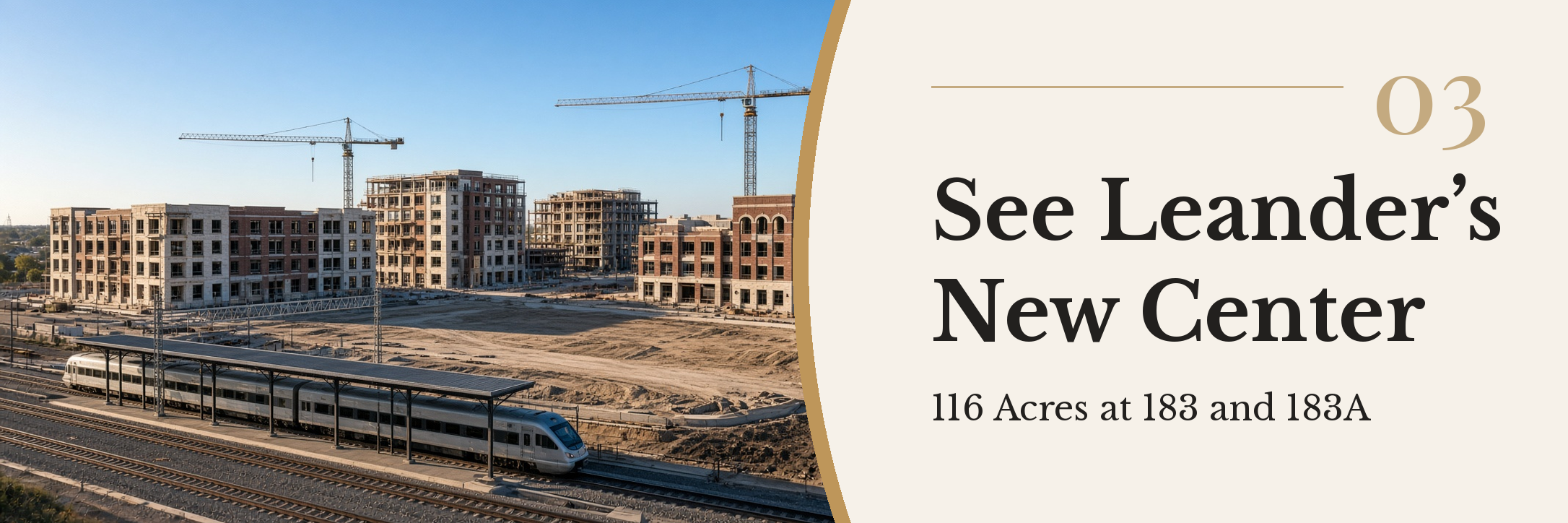
A true downtown, built from the ground up on 116 acres at 183 and 183A, next to Leander Station, the northern terminus of the Red Line with direct rail service into Austin. Full build-out is planned for 2031.
Leander has been one of the fastest-growing cities in the country for years, and you can feel it in the traffic and the new construction. What it's been missing is a center where all of that comes together. The full plan includes:
- Retail and restaurants
- Office space and a hotel
- Townhomes and condos
- Civic buildings and a town square
- Parks, water features, and public art
As of May 2026, multiple buildings are already going up. In February 2026, the Leander City Council approved a deal to build a large office building here for the city's own offices and council chambers. They're moving city government into this development. That's a long-term commitment, and it tells you how seriously they're backing it.
St. David's has a full-service hospital planned right next to the site, and Austin Community College already has its San Gabriel campus up and running nearby. Healthcare, transit, city government, retail, and housing are all coming together in one place.
Right now you're buying into a place with cranes up and a town square still on paper. By 2031, that same spot should have a real downtown, a hospital, a city hall, and direct rail into Austin, with pricing that reflects all of it. That gap is where the opportunity sits.
What is The District in Round Rock, TX?
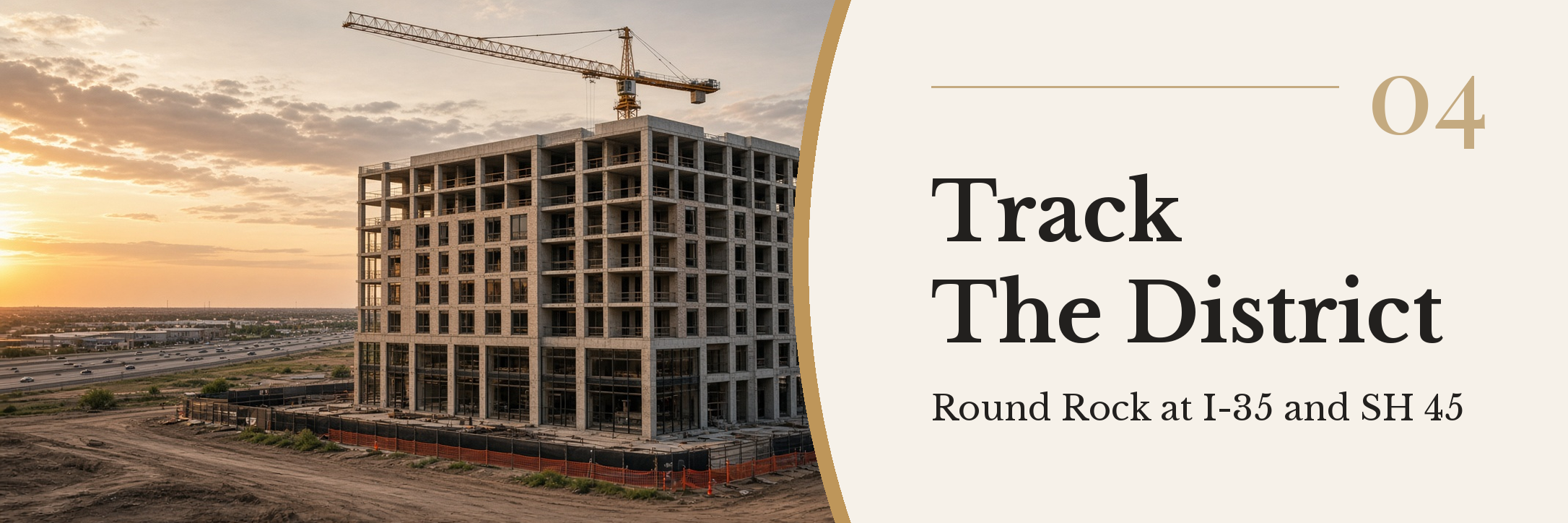
The District is a 65-acre development at I-35 and Highway 45, right across from Dell's campus, and it's Round Rock's shot at a walkable downtown core. It's been in the works for about 8 years, and now it's actually getting built.
Round Rock has always had the bones: Dell headquarters and a strong retail corridor with solid fundamentals. What it's never really had is a place where you park, get out, and just spend an afternoon.
The District was first approved in 2019, pushed through the pandemic and a tough capital market, and finally broke ground in March 2025. As of late March 2026, the Round Rock Chamber confirmed vertical construction is underway on the first building, Origin at The District. It's a seven-story residential building with retail on the ground level, fully financed, with a targeted completion of early 2028.
At full build-out, around 2039, the plan includes office space, retail, more than 1,000 residential units, hotel space, and thousands of jobs on site.
Why is Round Rock's timing interesting for buyers?
As of May 2026, Round Rock home values have pulled back from their peak, inventory is up, and the market has cooled. That correction is real. At the same time, a major project is actively under construction, and pricing still reflects where things are today.
That combination doesn't show up often in a market with this kind of foundation. Buyers getting into Round Rock before that ribbon cutting are getting in ahead of what completion brings. Once the building is done, that window closes.
Is Austin's light rail actually being built?
Yes. Project Connect, Austin's light rail, is moving into construction. In January 2026, the Federal Transit Administration signed off on the full environmental review. It wrapped up in just under two years, and the FTA called it a best practice for a project this size.
In February 2026, the Austin Transit Partnership approved a $60 million design-build contract, the first major construction contract for the system. Its CEO said crews were expected on site within a few months.
- The system is planned to run about 10 miles with around 15 stations.
- About half the funding is expected to come from federal grants. The rest comes from local taxes and bonds that voters already approved.
- The FTA gave it a strong funding rating this cycle.
- Construction is targeting 2027, with trains expected to run around 2033.
One thing I want to be clear about. As of May 2026, there's still a state-level legal challenge over how the project is funded, and it's working its way through the courts. The federal approvals are done, and the Austin Transit Partnership is working to validate the funding in court. If you're making a long-term decision, keep an eye on it.
What about passenger rail between Austin and San Antonio?
Right now it's a study, not an active project. Travis County approved a feasibility study in late 2025, and the Texas Department of Transportation is running a separate corridor study alongside it.
The proposed route runs from downtown Austin east along Highway 71, then south on 130, and into San Antonio. There's no funding locked in, no final route, no operator, and no construction timeline.
If it does move forward, it would be a major shift for the 130 corridor, which already runs through some of the fastest-growing parts of Williamson and Travis counties. It's something to watch and understand, not something to act on yet.
How does the 183 North project change the commute from Cedar Park and Leander?
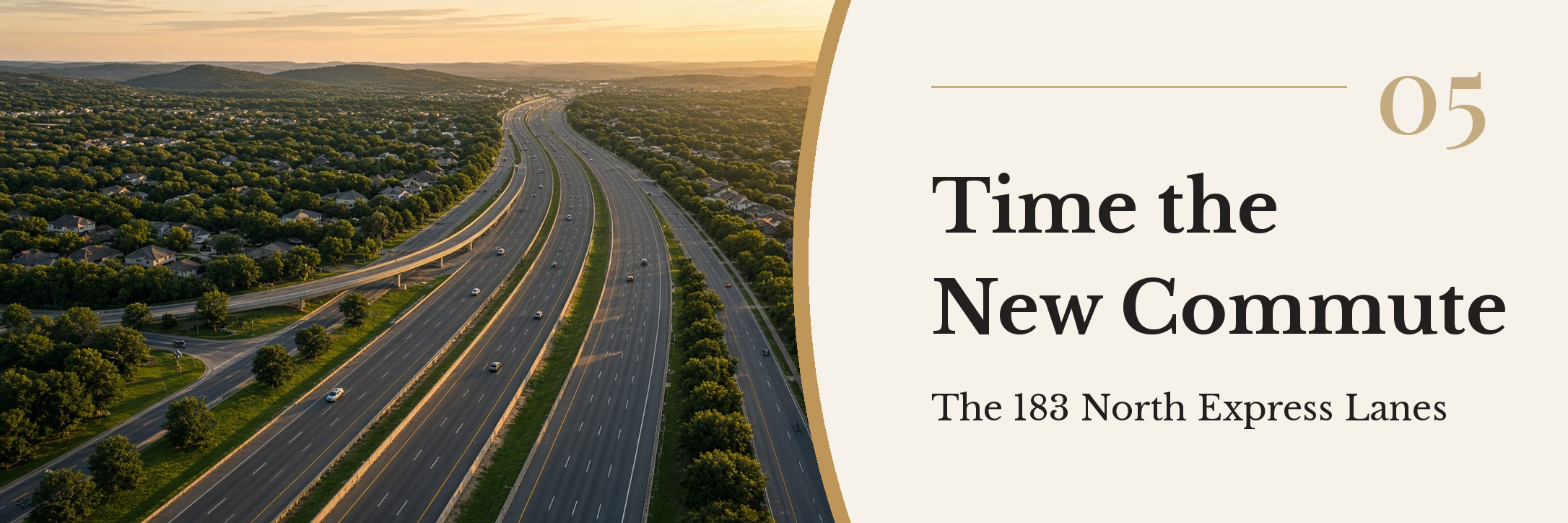
It makes it a lot faster, and it's already open. The 183 North Mobility Project is about a $600 million rebuild of the 9-mile stretch that connects Cedar Park and Leander to MoPac and central Austin. The express lanes opened in January 2026, the southbound side followed, and as of May 2026 the road is fully open.
By 2035, the Mobility Authority expects the express lanes to deliver a reliable 9-minute trip through the corridor at peak times. Even in the regular lanes, it projects the morning drive to run about 24 minutes faster than it would have without the project. Capital Metro buses also run the express lanes without a toll.
Projects like this don't get a lot of attention, but they matter more than people think. When the drive gets easier, more people are willing to live there, and that demand builds over time. If the commute was the thing holding you back from Cedar Park or Leander, that concern just got a lot smaller.
There's still some finishing work, like landscaping, sidewalks, and trail connections, set to wrap up through the spring and summer of 2026. A few nearby connector projects are aiming for 2027. But the road already works today, and it's only getting better.
Why are all these North Austin projects happening at the same time?
None of this is random. These projects feed into each other, and once you see how, you get a much clearer read on how strong this growth actually is.
- It starts with the CHIPS Act. That kicked off a national push for semiconductor manufacturing, and Central Texas picked up a big share. Samsung's Taylor campus set it in motion, then suppliers followed, along with workforce programs at Austin Community College and Texas State Technical College.
- Texas makes it easier to keep moving. No state income tax, a business-friendly setup, and lower operating costs than coastal tech cities. According to Opportunity Austin, this region has been the fastest job creator among large US metros since 2004.
- The way people work has changed. With remote and hybrid setups, areas that felt too far a few years ago make sense if you're only in the office two or three days a week. The suburbs aren't a fallback anymore. People choose them on purpose.
- The infrastructure is catching up. The 183 North project, the I-35 Capital Express rebuild running through 2033, and light rail are all a response to years of growth that outpaced the roads and transit.
The areas seeing the most growth are the same ones getting the biggest upgrades. That's a coordinated push, not something happening by chance.
Should you buy in North Austin now or wait until it's built out?
It depends on whether you're okay living somewhere while it's still coming together. Get in early and you're buying at today's pricing, but the full lifestyle isn't there yet. Wait, and everything is built out and running, but the pricing reflects that, and it usually keeps climbing from there.
As of May 2026, that earlier window is still open in a few of these areas:
- Taylor and Hutto: the Samsung campus hasn't started full production yet, and a lot of the workforce growth is still ahead.
- Leander: the town center is still under construction, with full build-out planned for 2031.
- Round Rock: major development is underway at the same time prices have pulled back.
- Cedar Park and Leander: the 183 North express lanes have already made the commute a lot smaller.
If you're making a long-term decision, think of these as 5-to-10-year growth plays. The buyers who tend to do best are okay being there while it's still growing instead of waiting for it to be finished. They move before prices catch up to what everyone else is starting to see.
Frequently asked questions
What megaprojects are being built in North Austin, TX?
As of May 2026, the biggest North Austin, TX megaprojects are Samsung's chip campus in Taylor, the Flora community and the Hutto Megasite in Hutto, a 116-acre town center in Leander, The District in Round Rock, Austin's Project Connect light rail, and the rebuilt 183 North highway. Together they bring jobs, infrastructure, and density to the stretch from Round Rock to Taylor at the same time.
When will Samsung's plant in Taylor, TX open?
As of May 2026, Samsung was aiming to have operations at its Taylor, TX campus up and running by the end of 2026. Fab 1 has been under construction since 2022, employees started moving into the on-site office building in late 2025, and Samsung is working through approvals for a second facility, Fab 2, with no set timeline yet.
What is Flora in Hutto, TX?
Flora is an 835-acre master-planned community in Hutto, TX, about 5 miles from Samsung's Taylor campus, with about 2,800 single-family homes expected at full build-out. As of May 2026, phase one was open with eight builders and prices from the $300s into the $800s. It's built around a market square, a clubhouse with co-working, beach-entry pools, and trails along a creek.
When will the new Leander, TX town center be finished?
Full build-out of Leander, TX's new town center is planned for 2031. The 116-acre project at 183 and 183A, next to Leander Station on the Red Line, includes retail, restaurants, offices, a hotel, townhomes, condos, a town square, and the city's own offices and council chambers. A St. David's hospital is planned next door. As of May 2026, multiple buildings were going up.
Did the 183 North project make the Cedar Park, TX commute faster?
Yes. The 183 North Mobility Project rebuilt the 9-mile stretch of US 183 that links Cedar Park and Leander to MoPac and central Austin, and its express lanes opened in early 2026. The Mobility Authority projects a reliable 9-minute peak trip in the express lanes by 2035, and a morning drive about 24 minutes faster in the regular lanes than without the project.